Your baby doesn’t care whether you can hold a tune. To them, your singing voice is one of the most interesting sounds in the world. Here is what researchers have found when they watched, measured and listened to babies being sung to, and what it means for the songs you share at home and in class.
In a nutshell
- Babies respond to sound from around 19 weeks of pregnancy, and can recognise tunes they heard in the womb for weeks or even months after birth.
- In a lab study, babies stayed calm for about 9 minutes while listening to a song, roughly twice as long as when they heard speech.
- Familiar songs seem to work best. Babies settle and smile more to a song they already know.
- Lullabies are found all over the world, and babies relax to them even when the language is completely new.
- Singing with your baby is good for grown-ups too. Two UK trials found group singing helped mums’ postnatal depression symptoms ease faster, or stay lower for longer.
It starts before birth
Hearing develops surprisingly early. In a classic study that played tones to babies in the womb, the first responses appeared at 19 weeks of pregnancy. By 27 weeks almost all babies reacted to low and middle notes, and higher notes followed a few weeks later.1 So low and middle-pitched sounds, including voices, reach your baby first.
Babies don’t just hear before birth; they remember. In a French study, mums played a short, nine-note piano tune lasting 3.6 seconds twice a day from 35 weeks of pregnancy. About a month after birth, and roughly six weeks after they last heard it, the babies’ heart rates still slowed when the tune played, a sign they were paying attention to something familiar.2
In Finland, a small group of babies heard “Twinkle, Twinkle, Little Star” from a CD, around 171 times on average in late pregnancy. Their brains responded differently to the tune at birth and again at four months old, compared with babies who hadn’t heard it.3
Even newborn cries carry a trace of the womb. Researchers recorded 60 babies aged three to five days: French newborns tended to cry with a rising melody and German newborns with a falling one, matching the “tune” of each language.4
What this doesn’t mean
None of these studies show that playing music to your bump makes a baby cleverer. They show that babies arrive already familiar with the sounds of home. That’s a lovely reason to keep singing the songs you sang in pregnancy.
Born listening
All over the world, parents change the way they sing when a baby is listening. In a study of mums and dads singing a song of their choice, the versions sung to a real baby were higher and slower, and listeners could tell them apart from “pretend” versions just from the recordings.5 It seems to come naturally, and dads do it too.
What grabs a baby’s attention most is a happy voice. When researchers pitted baby-talk against singing, babies chose whichever sounded happier, whether it was spoken or sung.6 So the best voice for your baby is simply yours, sung with a smile.
Brain recordings also suggest that sleeping newborns notice when a strong beat goes missing from a rhythm. That work comes from a single research group so far, but it hints that babies are tuned in to rhythm from the first days of life.7
Singing keeps babies calm for longer
A team in Montréal played recordings to babies under a year old and timed how long it took for the first “cry face” to appear. Listening to an unfamiliar Turkish play song, babies stayed content for about 9 minutes. With baby-talk it was just over 4 minutes, and with ordinary adult speech just under 4.8 Singing roughly doubled the time before distress, even in a language the babies had never heard.
Familiar songs seem to be even more powerful. In a Toronto study, parents first played normally with their 8- or 10-month-old, then briefly went still and unresponsive (a mild, harmless stressor that babies dislike). When parents then talked, babies became more upset. When they sang, babies paid more attention and fussed less, and a familiar song brought the biggest benefit and the most smiles.9
Singing at home makes a difference too. In a 2025 randomised trial, 110 families were encouraged through a short smartphone programme to sing more to their babies (average age nearly four months). Singing went up, and parents reported that their babies were in a better mood overall.10
Lullabies: a language every baby understands
Songs to soothe babies turn up all over the world. A huge study of music across cultures, the Natural History of Song, found music “in every society observed”, with infant care among the main reasons people sing.11
Lullabies are also strikingly easy to recognise. When 750 people in 60 countries heard 14-second clips of songs from 86 mostly small-scale societies, they picked out lullabies as songs “to soothe a baby” in 29 out of 30 world regions. Lullabies tend to be slower, simpler and softer, with fewer voices and instruments.12 A later project with over 51,000 listeners in 187 countries found that people can often tell, better than chance, when someone is singing to a baby rather than to an adult.13
Babies seem to “get” lullabies too. When 144 American babies heard eight lullabies from faraway cultures, in languages they didn’t know, their heart rates slowed, their pupils dilated less and their skin showed less arousal, compared with other unfamiliar foreign songs, such as dance, love and healing songs.14 The effect was there across the whole first year.
Why we sing the same songs every week
For babies, a song is more than a tune. It can be a social signal. In a Harvard study, parents sang a new song to their 5-month-olds at home for one to two weeks. Back in the lab, the babies paid more attention to a stranger singing that same song than to one singing a different tune. Babies who learned the song from a toy, or from a friendly adult who wasn’t a parent, showed no such preference.15 The song seemed to say “this person is one of us”.
By 14 months, toddlers were more likely to help a grown-up who had just sung to them (or recited the words to them), picking up things she “accidentally” dropped. And the more familiar the song, the more they helped the singer.16
This is why repetition matters. The NHS puts it simply: babies love to hear the same songs and rhymes over and over again, and they need lots of repetition to learn words.17
Good for grown-ups too
Singing isn’t only for the baby’s benefit. In a small UK study, 43 mums took part in two group sessions with their babies: one of singing and one of play and chat. After singing, mums felt closer to their babies, were in a better mood, and their stress-hormone levels fell more than after the play session.18
Two UK randomised trials have looked at mums with postnatal depression. In the first, mums with moderate to severe symptoms who joined a free, 10-week mother-and-baby singing group improved faster over the first six weeks than mums receiving usual care.19 In a larger trial published in 2025 (199 mums in south London), both groups improved at first, but mums in the singing group then had significantly fewer symptoms than mums who went to other mother-and-baby activities, at 20 and 36 weeks, about six months after the course ended.20
That matters, because early parenthood can be lonely. In a 2025 poll of 2,010 UK parents for the charity NCT, 62% of new parents said they feel lonely or isolated at least some of the time.21 Yet only about half of parents of under-fives (52%) sing songs or rhymes with their child every day.22
A note of care
Singing groups can support recovery, but they are not a treatment on their own. If you are struggling with low mood after having a baby, please talk to your GP or health visitor. You don’t have to wait until things feel serious.
Lullabies and bedtime
A calm, regular bedtime routine (a bath, a massage, then quiet cuddles and singing, with lights out soon after) helped babies and toddlers fall asleep faster and wake less in a three-week trial with 405 families, and mums’ mood improved too.23 The routine worked as a whole, so we can’t say the song did it alone. But a lullaby is a lovely, calming way to signal “it’s nearly time for sleep”.
What the science doesn’t say
- “Singing releases the love hormone.” You may read that singing floods you and your baby with oxytocin. Two small hospital studies with premature babies have measured it. In 20 mums, oxytocin rose about as much when they talked to their babies as when they sang.24 In the babies, oxytocin rose clearly when mum talked, but not when she sang.26 Studies in adult singers are mixed.25 We prefer to talk about what we can see: calmer, happier, closer moments.
- “Lullabies make babies sleep through the night.” Not proven. Bedtime routines that include singing help; lullabies on their own haven’t been tested for sleep.
- “Music in the womb makes babies smarter.” No. It makes sounds familiar, which is lovely in its own right.
How this shapes a StoryBox class
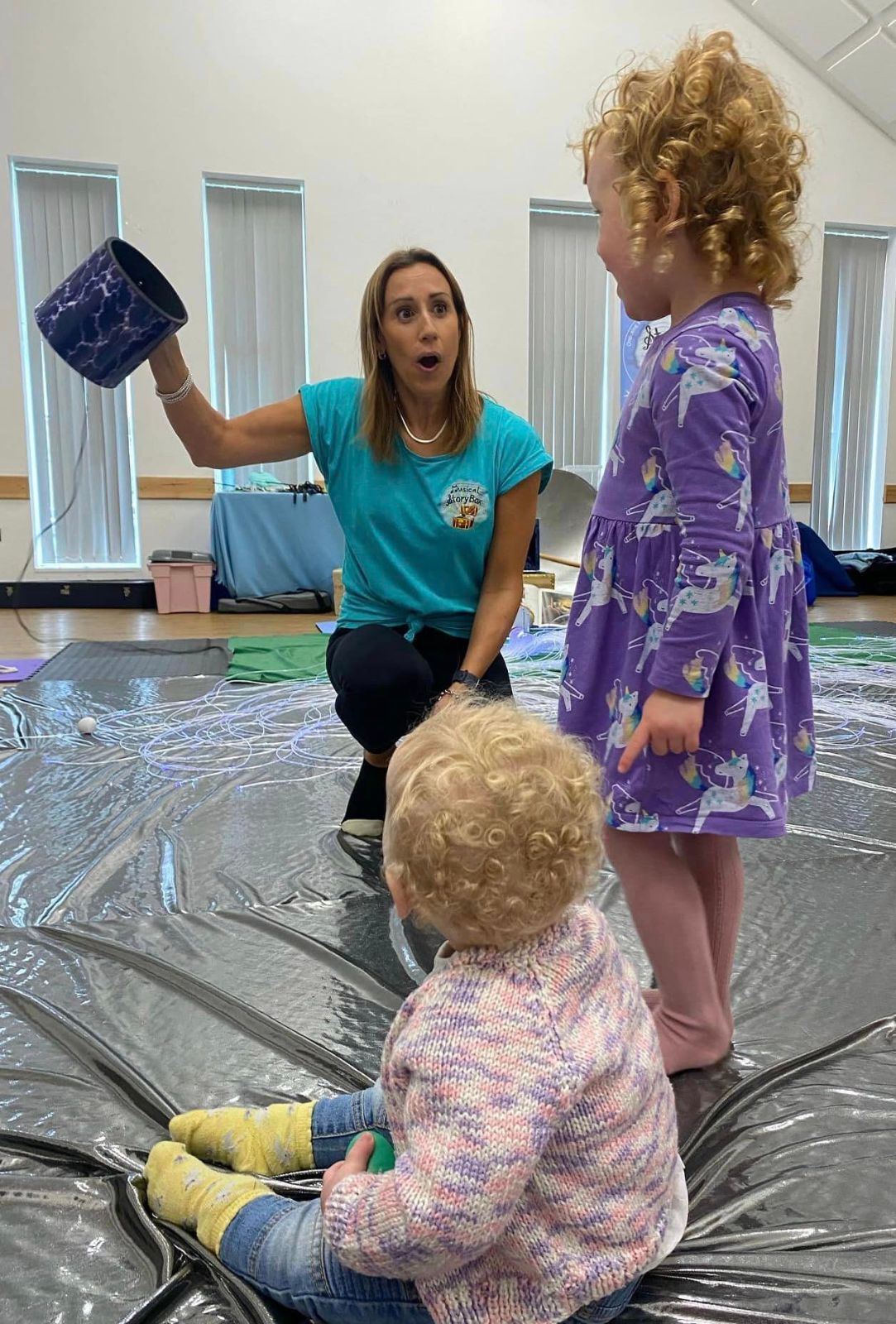
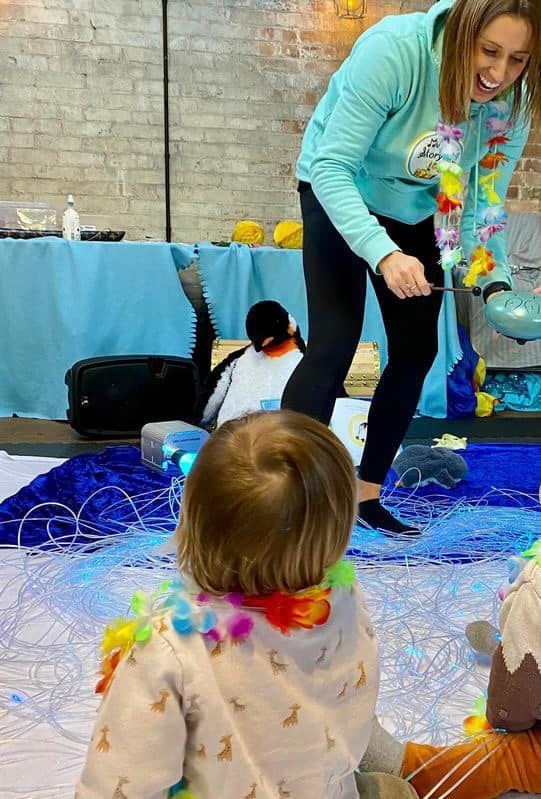
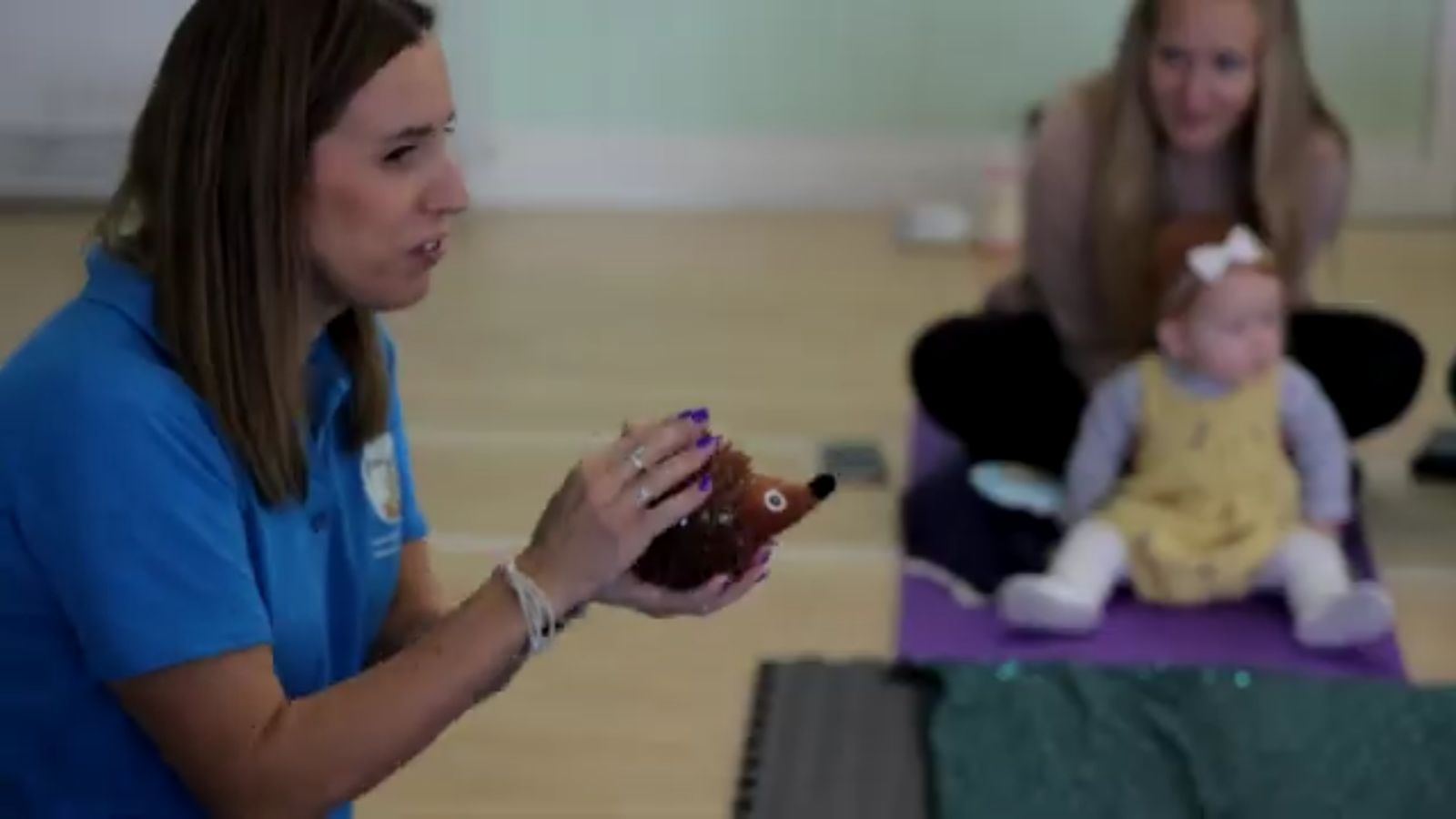
Every class starts with the same welcome song and ends with a lullaby, so the songs become familiar friends. Towards the end we choose a nursery rhyme everyone knows and the grown-ups sing it to their own little ones. It is one of our favourite moments: you can see babies switch their attention from us at the front to the voice they love best.
Try it at home
Pick one song for a daily moment (nappy changes, the car, the bath) and sing it the same way every time. Use the songs from class: babies seem to treat songs from their own grown-ups as extra special. And don’t worry about your voice. Happy beats perfect.
References
Sources checked October 2026. Where a study was small or early, we say so in the text.
- Hepper PG, Shahidullah BS (1994). Development of fetal hearing. Archives of Disease in Childhood – Fetal and Neonatal Edition, 71(2), F81–F87. fn.bmj.com/content/71/2/F81
- Granier-Deferre C, Bassereau S, Ribeiro A, Jacquet A-Y, DeCasper AJ (2011). A melodic contour repeatedly experienced by human near-term fetuses elicits a profound cardiac reaction one month after birth. PLoS ONE, 6(2), e17304. doi.org/10.1371/journal.pone.0017304
- Partanen E, Kujala T, Tervaniemi M, Huotilainen M (2013). Prenatal music exposure induces long-term neural effects. PLoS ONE, 8(10), e78946. doi.org/10.1371/journal.pone.0078946Small study: 10 exposed babies were tested at birth and 4 months.
- Mampe B, Friederici AD, Christophe A, Wermke K (2009). Newborns’ cry melody is shaped by their native language. Current Biology, 19(23), 1994–1997. doi.org/10.1016/j.cub.2009.09.064
- Trehub SE, Unyk AM, Kamenetsky SB, Hill DS, Trainor LJ, Henderson JL, Saraza M (1997). Mothers’ and fathers’ singing to infants. Developmental Psychology, 33(3), 500–507. trainorlab.mcmaster.ca
- Corbeil M, Trehub SE, Peretz I (2013). Speech vs. singing: infants choose happier sounds. Frontiers in Psychology, 4, 372. doi.org/10.3389/fpsyg.2013.00372
- Winkler I, Háden GP, Ladinig O, Sziller I, Honing H (2009). Newborn infants detect the beat in music. PNAS, 106(7), 2468–2471. doi.org/10.1073/pnas.0809035106; and Háden GP, Bouwer FL, Honing H, Winkler I (2024). Beat processing in newborn infants cannot be explained by statistical learning based on transition probabilities. Cognition, 243, 105670. doi.org/10.1016/j.cognition.2023.105670
- Corbeil M, Trehub SE, Peretz I (2016). Singing delays the onset of infant distress. Infancy, 21(3), 373–391. doi.org/10.1111/infa.12114
- Cirelli LK, Trehub SE (2020). Familiar songs reduce infant distress. Developmental Psychology, 56(5), 861–868. doi.org/10.1037/dev0000917
- Cho E, Yurdum L, Ebinne E, Hilton C, Lai E, Bertolo M, Brown P, Milosh B, Sened H, Tamir DI, Mehr SA (2025). Ecological momentary assessment reveals causal effects of music enrichment on infant mood. Child Development, 96(4), 1555–1567. doi.org/10.1111/cdev.14246Infant mood was reported by parents.
- Mehr SA, Singh M, Knox D, et al. (2019). Universality and diversity in human song. Science, 366(6468), eaax0868. doi.org/10.1126/science.aax0868
- Mehr SA, Singh M, York H, Glowacki L, Krasnow MM (2018). Form and function in human song. Current Biology, 28(3), 356–368. doi.org/10.1016/j.cub.2017.12.042
- Hilton CB, Moser CJ, Bertolo M, et al. (2022). Acoustic regularities in infant-directed speech and song across cultures. Nature Human Behaviour, 6(11), 1545–1556. doi.org/10.1038/s41562-022-01410-x
- Bainbridge CM, Bertolo M, Youngers J, et al. (2021). Infants relax in response to unfamiliar foreign lullabies. Nature Human Behaviour, 5(2), 256–264. doi.org/10.1038/s41562-020-00963-z
- Mehr SA, Song LA, Spelke ES (2016). For 5-month-old infants, melodies are social. Psychological Science, 27(4), 486–501. doi.org/10.1177/0956797615626691
- Cirelli LK, Trehub SE (2018). Infants help singers of familiar songs. Music & Science, 1. doi.org/10.1177/2059204318761622
- NHS Best Start in Life. Baby’s first sounds: 0 to 6 months. nhs.uk/best-start-in-life
- Fancourt D, Perkins R (2018). The effects of mother–infant singing on emotional closeness, affect, anxiety, and stress hormones. Music & Science, 1. doi.org/10.1177/2059204317745746Small study (43 mums), single sessions.
- Fancourt D, Perkins R (2018). Effect of singing interventions on symptoms of postnatal depression: three-arm randomised controlled trial. British Journal of Psychiatry, 212(2), 119–121. doi.org/10.1192/bjp.2017.29The faster improvement was seen in mums with moderate to severe symptoms; by week 10 all groups were similar.
- Bind R, et al. (2025). Clinical effectiveness, implementation effectiveness and cost-effectiveness of a community singing intervention for postnatal depressive symptoms, SHAPER-PND: randomised controlled trial. British Journal of Psychiatry, 227(6). doi.org/10.1192/bjp.2025.10377; summary: King’s College London, 15 October 2025
- NCT (2026). From expectation to reality: parents’ experiences of pregnancy, birth, and life with a newborn. Censuswide poll of 2,010 parents, September 2025. nct.org.uk
- National Literacy Trust (2026). Parents’ support for young children’s literacy at home in 2026. Survey of 3,194 parents of children aged 0 to 5. literacytrust.org.uk
- Mindell JA, Telofski LS, Wiegand B, Kurtz ES (2009). A nightly bedtime routine: impact on sleep in young children and maternal mood. Sleep, 32(5), 599–606. Summary: American Academy of Sleep MedicineFunded by Johnson & Johnson; sleep was reported by mums.
- Filippa M, Monaci MG, Spagnuolo C, Di Benedetto M, Serravalle P, Grandjean D (2023). Oxytocin levels increase and anxiety decreases in mothers who sing and talk to their premature infants during a painful procedure. Children, 10(2), 334. doi.org/10.3390/children10020334Small study (20 mothers); oxytocin rose with both singing and talking.
- Schladt TM, Nordmann GC, Emilius R, Kudielka BM, de Jong TR, Neumann ID (2017). Choir versus solo singing: effects on mood, and salivary oxytocin and cortisol concentrations. Frontiers in Human Neuroscience, 11, 430. doi.org/10.3389/fnhum.2017.00430; and Kreutz G (2014). Does singing facilitate social bonding? Music and Medicine, 6(2), 51–60. mmd.iammonline.comOxytocin fell after choir singing in one study and rose more after singing than chatting in the other.
- Filippa M, Monaci MG, Spagnuolo C, Serravalle P, Daniele R, Grandjean D (2021). Maternal speech decreases pain scores and increases oxytocin levels in preterm infants during painful procedures. Scientific Reports, 11, 17301. doi.org/10.1038/s41598-021-96840-4Small study of premature babies in hospital; the babies’ oxytocin rose significantly with mum’s speech but not with her singing.