8 minute read
The science of singing to your baby
In a lab study, babies stayed calm about twice as long when they heard singing. Lullabies soothe across cultures, and singing groups can ease postnatal depression symptoms too.
Read the science
Why music matters
Music, songs and stories do wonderful things for babies and toddlers. Here are the benefits, and the research behind every one. Tap or hover over a card to flip it and see the fact.
In the first few years of life, more than a million new connections form in a child’s brain every second, and everyday moments with the people they love help shape them. Music is one of the most joyful of those moments. Every claim below comes with the study behind it, and where the evidence is small or early, we say so.
Benefit 1 of 6
Music is one of the oldest soothers there is, and the research backs up what parents have always known.
In a Montréal lab study, babies under a year listened to recordings until they started to get upset. With a song they stayed content for about 9 minutes; with baby-talk, just over 4.
Corbeil, Trehub & Peretz, Infancy, 2016
After a short, mildly upsetting moment, 8 and 10-month-olds settled better when a parent sang than when they talked, and a song they already knew brought the biggest benefit and the most smiles.
Cirelli & Trehub, Developmental Psychology, 2020
144 American babies heard eight lullabies from faraway cultures, in languages they didn’t know. Compared with other unfamiliar songs, such as dance, love and healing songs, their heart rates slowed and their pupils dilated less, both signs of relaxing.
Bainbridge et al., Nature Human Behaviour, 2021
Researchers played recordings to babies under a year old and timed how long they stayed content before they started to get upset. Press play to watch it happen, speeded up.
Benefit 2 of 6
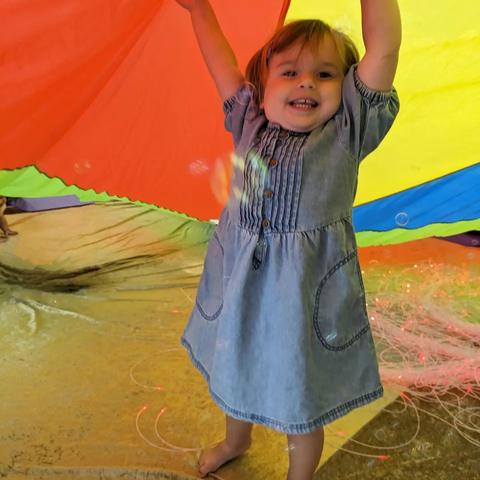
Making music together pulls little people towards each other, and towards you.
14-month-olds who were bounced in time with a grown-up were about twice as likely to help her, without being asked, when she “dropped” things (25.8% vs 13.1% of chances) as babies bounced out of time.
Cirelli, Einarson & Trainor, Developmental Science, 2014
Five-month-olds whose parents sang them a new song at home paid more attention to a stranger singing that same song. Babies who learned it from a musical toy showed no such interest.
Mehr, Song & Spelke, Psychological Science, 2016
After a game with singing, dancing and instruments, pairs of 4-year-olds helped and cooperated more than pairs who played the same game without music, and talked to each other almost twice as much while working together on a marble game.
Kirschner & Tomasello, Evolution and Human Behavior, 2010
Press start, listen to four clicks, then tap the drum (or press the space bar) on every click. We’ll tell you how close you were.
Moving in time together is something even babies respond to. See how you do.
Benefit 3 of 6
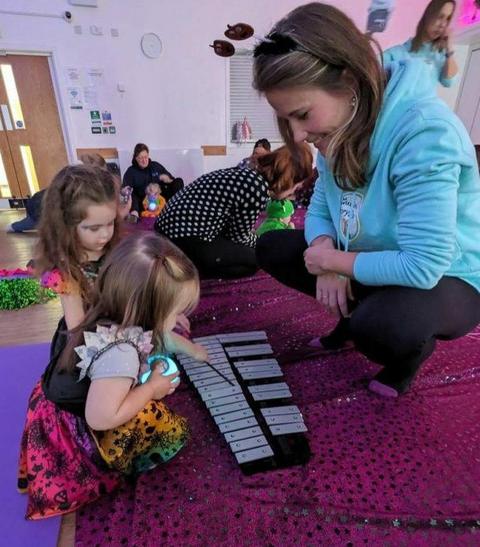
Waiting for the music, keeping the beat and stopping on cue: this is what “discipline” is really made of.
Listening, waiting and stopping on cue are all part of self-regulation, which grows fast between three and five. Reviews pooling studies of music sessions for children find small gains, with the clearest effect on stopping yourself. Many of the studies are small, so this is promising rather than proven.
Lu, Shi & Musib, 2024; Cai, Kang & Xu, 2025; both Frontiers in Psychology
In an Australian trial with 213 preschoolers, eight weeks of rhythm-and-movement games improved self-regulation, and the benefits were still there six months later, after the children had started school.
Bentley et al., Developmental Science, 2023
In a German study with blinded testers, 5 and 6-year-olds who did 20 weeks of short rhythm sessions improved more on a “stay still like a statue” test than children who did a sports programme.
Frischen, Schwarzer & Degé, Frontiers in Integrative Neuroscience, 2019
Press start and shake along (tap the shaker or press the space bar). When the music stops, freeze! Four rounds.
Ready?
Stopping on cue is harder than it looks. That pause is self-control at work.
Benefit 4 of 6
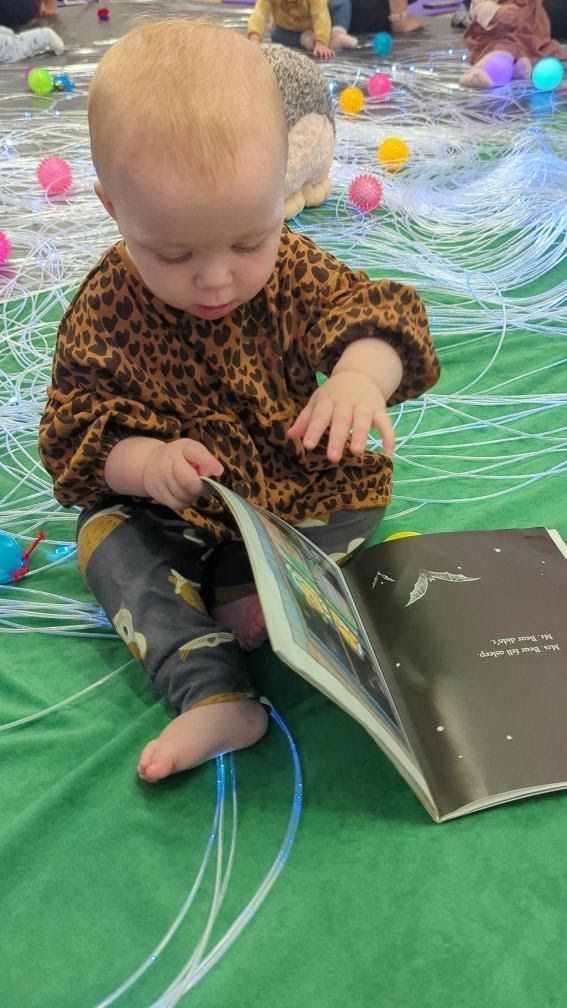
Rhyme, rhythm and stories lay the foundations children later use to read.
Picture books use a wider range of words than everyday chat. Counting the words in popular children’s books, researchers worked out that one book a day adds up to nearly 300,000 words heard by five.
Montag, Jones & Smith, Psychological Science, 2015; Logan et al., Journal of Developmental and Behavioral Pediatrics, 2019
In a study of 28 newborns, babies’ brains picked out “words” in a stream of made-up syllables only when it was sung, not spoken. Those brain responses helped predict vocabulary at 18 months. It’s a small study, but a lovely one.
François et al., Scientific Reports, 2017
In a UK study that followed 64 children, those who knew more nursery rhymes at three read and spelled better at six, even allowing for background and IQ. Rhymes seem to tune children in to the sounds inside words.
Bryant, Bradley, Maclean & Crossland, Journal of Child Language, 1989
Benefit 5 of 6
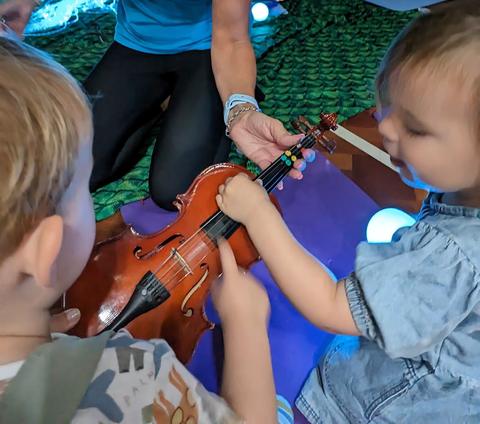
Babies arrive with remarkably open ears, and real, live music lights them up.
At a baby opera, babies watching live looked at the stage about 72% of the time, against 54% for babies watching an identical recording. Their heart rates even rose and fell together.
Kragness et al., Psychology of Aesthetics, Creativity, and the Arts, 2023 (one study)
Six-month-olds noticed changes in complex Balkan folk rhythms that most Western adults miss. By their first birthday they had tuned in to their own culture’s music, but about two weeks of listening at home brought the openness back.
Hannon & Trehub, Psychological Science and PNAS, 2005
Babies who sang, moved and played percussion with a parent in weekly classes from 6 months used more early gestures, like waving and pointing, by their first birthday (as reported by their parents) than babies whose class just had classical CDs playing in the background.
Gerry, Unrau & Trainor, Developmental Science, 2012 (a small study)
Run your finger or mouse across the strings, or tap them one at a time. Each one plays the real note of that instrument.
Benefit 6 of 6
The benefits aren’t only for the little ones.
In a UK trial, mums with more severe postnatal depression symptoms who joined a 10-week baby singing group improved faster than those receiving usual care. In a larger 2025 trial, mums in the singing group still had fewer symptoms than mums in other mother-and-baby groups six months after the course ended. If you are struggling, please also talk to your GP or health visitor.
Fancourt & Perkins, British Journal of Psychiatry, 2018; SHAPER-PND trial, British Journal of Psychiatry, 2025
In a small UK study of 43 mums, mums felt closer to their babies and in a better mood after a singing session than after a play session, and their stress-hormone levels fell more.
Fancourt & Perkins, Music & Science, 2018
Babies are drawn to a happy voice, sung or spoken. Parents naturally sing higher and slower to their babies, and dads do it too.
Corbeil, Trehub & Peretz, Frontiers in Psychology, 2013; Trehub et al., Developmental Psychology, 1997
There is a lot of hype about music and babies. Here’s the honest version.
The famous “Mozart effect” came from a 1993 study of 36 university students, whose scores on spatial puzzles rose for 10 to 15 minutes. Big reviews found tiny effects, and other music people enjoyed worked just as well. What does help is joining in: singing, moving and playing together.
Read about the Mozart mythYou will often read that singing floods you and your baby with oxytocin. Two small hospital studies with premature babies have measured it: mums’ oxytocin rose about as much when they talked as when they sang, and babies’ oxytocin rose clearly only when mum talked. Studies in adult singers are mixed. What research does show is that singing calms babies and helps mums feel closer.
Read about singing and bondingNewborn brains do notice a steady beat, and babies love moving to music. But keeping time comes later: the first signs appear at around two and a half, mostly when drumming with a real person rather than a machine. Until then, it’s the grown-up bouncing them in time who keeps the beat.
Read about rhythm and movementEvery fact on this page comes from published research, surveys or official guidance. These posts tell the full story, with every study listed.
In a lab study, babies stayed calm about twice as long when they heard singing. Lullabies soothe across cultures, and singing groups can ease postnatal depression symptoms too.
Read the scienceWhy waiting for the music, keeping a beat and stopping on cue are some of the best early practice for self-control.
Read the sciencePicture books, nursery rhymes and a sense of rhythm all feed the skills children later use to read.
Read the scienceBabies pay more attention to live performers, learn from a wide variety of music, and gain most when they join in rather than just listen.
Read the scienceEngland's early years music guidance says musicality is part of being human. Here's what it asks for, and how our classes fit.
Read the scienceA note on how we use research: no study has tested Musical StoryBox classes themselves. What we have done is read the studies behind each claim, checked the numbers at source, and told you where evidence is strong and where it is still early. Every source is listed on our fact sheet.
Live music, much-loved stories, songs and sensory play, every week. Find a class near you, or answer three quick questions to see which class suits your little one.