You may have heard that playing Mozart to a baby makes them cleverer. It doesn’t. But there are very good reasons to bring real instruments, lots of different music and plenty of joining in into a child’s life. Here is what the research really says.
In a nutshell
- Babies at a live baby-opera watched the stage 72% of the time, against 54% for babies watching an identical recording.
- Six-month-olds are musically open-minded: they pick up rhythms from unfamiliar cultures that adults struggle with. Hearing lots of different music helps keep those ears open.
- The “Mozart effect” came from a 1993 study of 36 university students. It was never about babies, and big reviews show it is tiny or non-existent.
- Joining in beats background music. In a small study, babies in active music classes did better on several measures than babies whose class just had classical CDs playing.
Why live music grabs attention
In a study published in 2023, researchers in Canada put on a 12-minute children’s opera for audiences of babies aged 6 to 14 months. Some audiences watched it live; others watched a recording projected so the performers looked the same size, distance and volume. Babies at the live show watched the stage about 72% of the time, compared with about 54% for the recording, and they paid attention in longer stretches. Their heart rates even sped up and slowed down together, as if the audience were sharing the experience.1
It isn’t only babies. Children aged 2½ to 4½ kept time more accurately when drumming with a real person than with a drum machine or a loudspeaker.2 And when someone sings to a baby, rhythm helps organise where the baby looks: in an eye-tracking study of 112 babies watching videos of people singing to them, 6-month-olds were more than four times as likely as chance to look at the singer’s eyes at moments timed to the beat.3
The likely reason live music works so well is social. A live performer looks at you, responds to you and shares the room with you. That is exactly what a recording can’t do.
Keeping it honest
The live opera study is a single study, and it measured attention, not learning. Nobody has yet shown that live music leads to better long-term development than recorded music. What we can say is that babies are more engaged by it, and engagement is where learning starts.
Every instrument has its own voice
Babies’ brains are ready for music from the start. Brain scans of newborns just one to three days old show specialised responses to music, mostly on the right side of the brain, which change when the music is made to clash or jump key.4
Babies also remember more than just the tune. When 6-month-olds heard a folk melody every day for a week, they seemed to remember not only the melody but also its speed and whether it was played on a piano or a harp.5 (The instrument part of that finding was on the edge of statistical significance, so it needs confirming.)
Seeing and hearing together helps too. Five-month-olds noticed a change in rhythm only when they could see and hear a hammer tapping it in sync, not when they could only see it or only hear it.6 That is one reason we love playing instruments up close: children can watch the bow move and the string vibrate while they hear the sound it makes.
Why we play such a variety of music
Here is one of our favourite findings. Western adults find it very hard to notice changes in the complex, lopsided rhythms of Bulgarian and Macedonian folk dances. Adults who grew up with that music find it easy. And North American 6-month-old babies? They noticed the changes in both simple and complex rhythms, just like the Balkan adults.7
By 12 months, babies had started to tune in to the rhythms of their own culture and had lost some of that openness. But after about two weeks of short daily listening to Balkan music at home, the 12-month-olds could spot the changes again. Adults given similar listening still couldn’t.8
That is a lovely argument for variety. The first year is a time when little ears are tuning in to the music around them, so it makes sense to fill it with lots of different sounds: classical, folk, songs from around the world, as well as children’s songs. The government’s own early years guidance says the same thing: “Introduce children to different styles of music and art.”9
Music tells the story’s feelings
Young children first “hear” emotion in music through its energy: fast and loud for excitement, slow and soft for calm. Even 5-year-olds can use tempo as an emotional clue, while hearing major and minor keys as happy and sad comes around school age.10 In one study of 76 children aged 3 to 6, even the youngest could pick out happy and sad music better than chance, and they found it slightly easier with instruments alone than with singing.11
That’s why we match big, dramatic music to big story moments: a thundering storm, a galloping chase, a magical tiptoe.
The Mozart myth
In 1993, a short paper in the journal Nature reported that 36 university students scored higher on spatial-reasoning puzzles from an IQ test, such as paper folding and cutting, after listening to 10 minutes of a Mozart sonata. The boost, equivalent to 8 or 9 “spatial IQ” points, lasted only 10 to 15 minutes.12 No babies were involved, and it was never a test of general intelligence.
The “Mozart effect” took off anyway. In 1998, the Governor of Georgia proposed spending $105,000 to give the family of every newborn baby a classical music recording.13
Science caught up. A 1999 review of 16 studies and 714 people found the effect was tiny: about 1.4 IQ points, and not statistically reliable.14 The biggest review, in 2010, pooled around 40 studies and more than 3,000 people. Any short-term boost was small, other kinds of music worked just as well as Mozart, and there were signs that unimpressive results had gone unpublished.15 In a UK experiment with over 8,000 ten- and eleven-year-olds, pop music, including a song by Blur, did better than Mozart on the same kind of paper-folding puzzle, probably because the children enjoyed it more.16 The best explanation is that enjoyable music briefly lifts mood and alertness.
So we don’t play classical music to make children cleverer. We play it because it is dramatic, beautiful and full of feeling, and it brings our stories to life.
Joining in beats background music
The difference that matters is between listening in the background and joining in. In a small Canadian study, babies started weekly classes with a parent at 6 months. In the active classes, families sang, moved and played percussion together. In the comparison classes, recorded classical music for babies played in the background while families played. By their first birthday, babies in the active classes showed earlier understanding of musical keys and, according to their parents, used more early gestures like waving and pointing, smiled more and were easier to soothe than babies in the comparison classes.17
It mirrors what happens with baby videos: in a study of 12 to 18-month-olds, watching a best-selling baby DVD for a month taught no more words than not watching it, while parents teaching the same words in everyday life did better.18 The government’s guidance for the early years even advises: “do not have music playing all the time”.9
Sensory play and puppets: what we can and can’t say
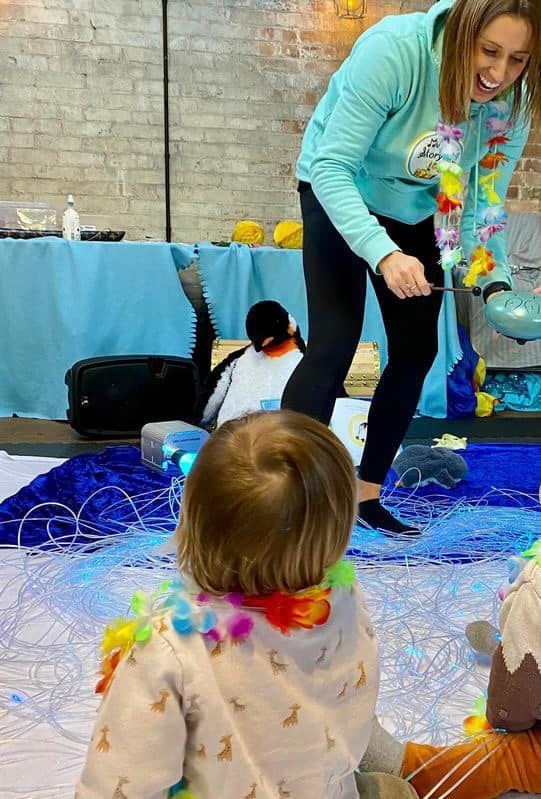
Bubbles, ribbons, lights, fabrics and parachutes are some of the most magical parts of a class. The research principle behind them is that babies pick up patterns more easily when sight, sound and touch happen together and in time.6 That’s why our props move with the music.
We want to be straight with you, though. We couldn’t find good studies showing that bubbles train eye-tracking, that ribbons build motor skills or that parachute games teach turn-taking. We use them because they are joyful, they invite looking, reaching and moving, and they turn a story into something you can feel.
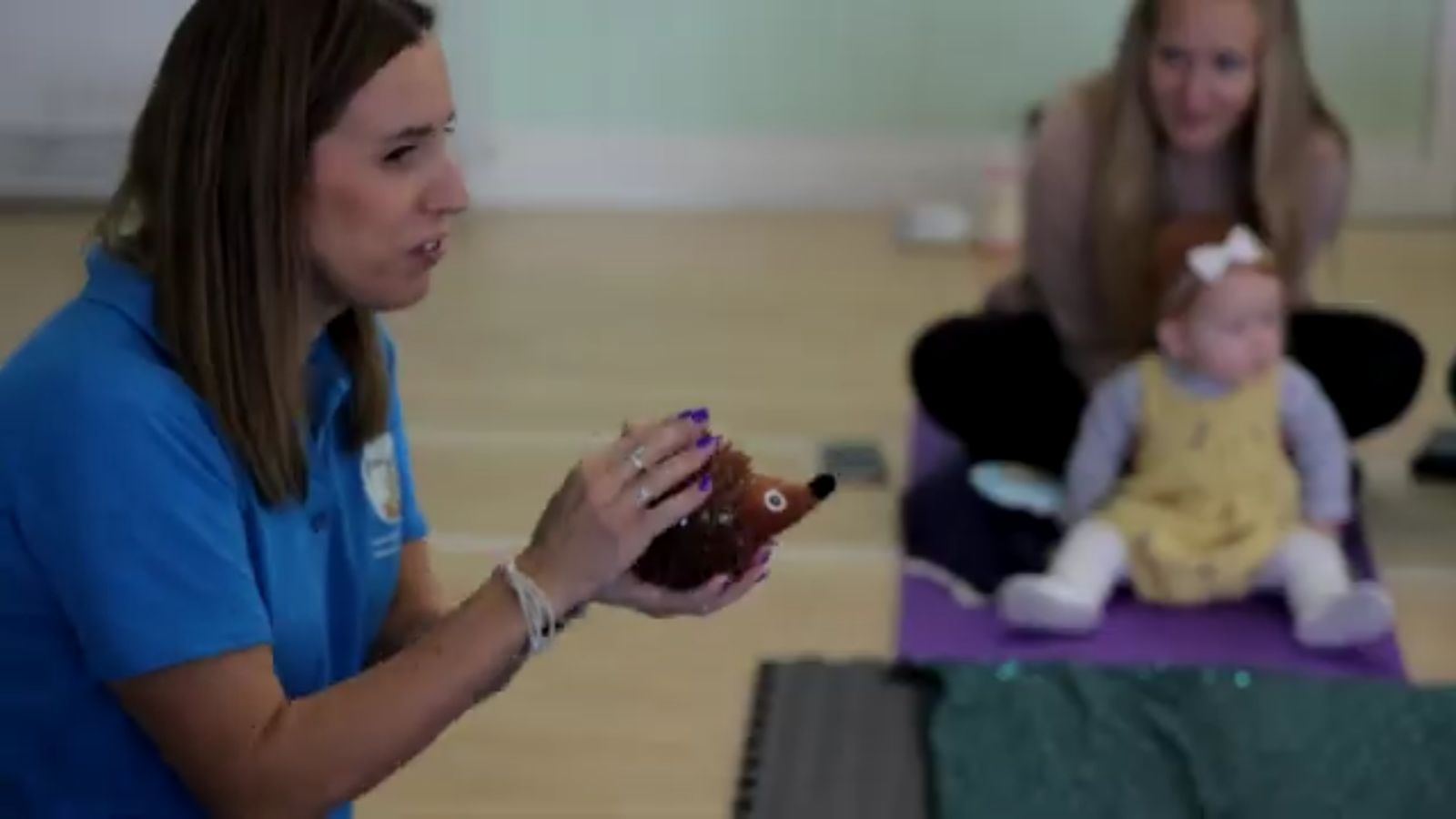
Puppets are brilliant at grabbing attention, and children do copy them. But a 2023 study found children aged 4 to 6 copied real adults and other children more than puppets.19 That is why our puppets always come with a real grown-up singing and playing alongside.
How this shapes a StoryBox class
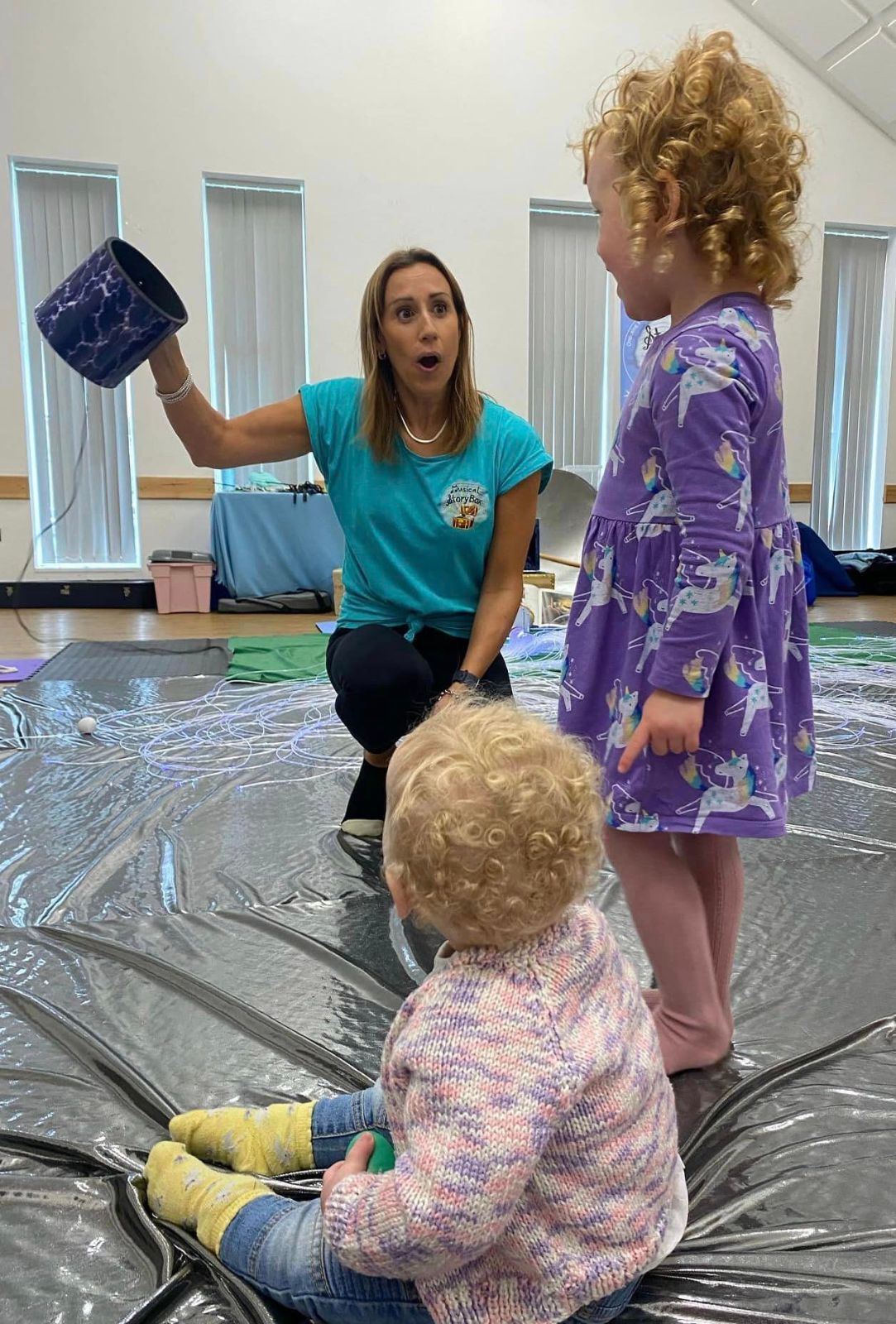
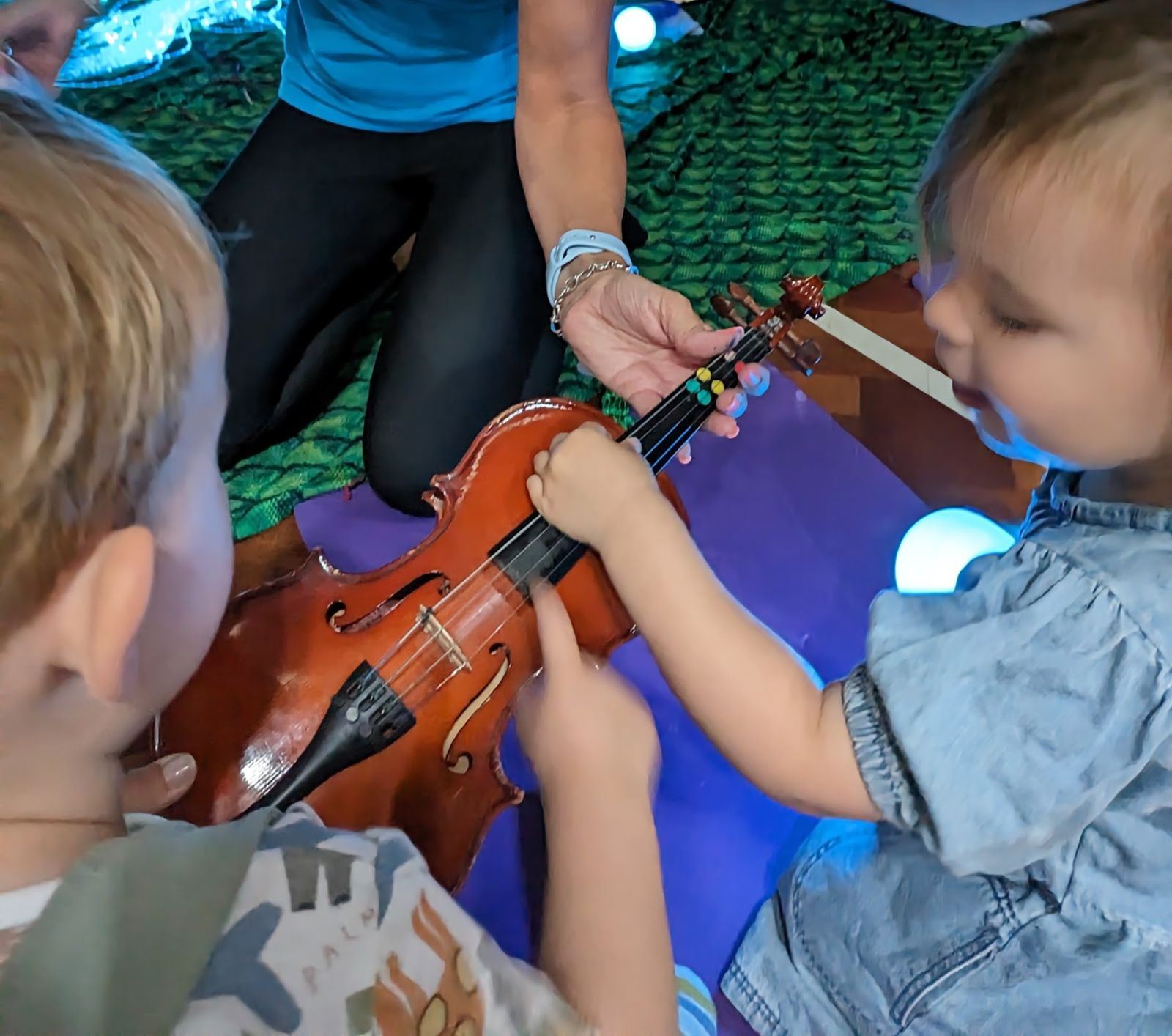
Every class has live music, played up close on real instruments such as the cello, violin, guitar or ukulele. We use a huge range of music, including lots of classical pieces chosen to match the drama of each story, alongside our own original songs. And nobody just sits and listens: everyone sings, moves, plays and joins in.
Try it at home
Swap one playlist a week: try film music, a world music station, jazz or a brass band. Then switch the music off and make your own: pots and wooden spoons, a rice shaker, your voice. Whatever you listen to, join in, because the joining in is the good bit.
References
Sources checked October 2026. Where a study was small or early, we say so in the text.
- Kragness HE, Eitel MJ, Anantharajan F, Gaudette-Leblanc A, Berezowska B, Cirelli LK (2023). An itsy bitsy audience: live performance facilitates infants’ attention and heart rate synchronization. Psychology of Aesthetics, Creativity, and the Arts, 19(5), 1124–1133. doi.org/10.1037/aca0000597; summary: University of Toronto News
- Kirschner S, Tomasello M (2009). Joint drumming: social context facilitates synchronization in preschool children. Journal of Experimental Child Psychology, 102(3), 299–314. doi.org/10.1016/j.jecp.2008.07.005
- Lense MD, Shultz S, Astésano C, Jones W (2022). Music of infant-directed singing entrains infants’ social visual behavior. PNAS, 119(45), e2116967119. doi.org/10.1073/pnas.2116967119
- Perani D, Saccuman MC, Scifo P, et al. (2010). Functional specializations for music processing in the human newborn brain. PNAS, 107(10), 4758–4763. doi.org/10.1073/pnas.0909074107
- Trainor LJ, Wu L, Tsang CD (2004). Long-term memory for music: infants remember tempo and timbre. Developmental Science, 7(3), 289–296. Trainor Lab PDF
- Bahrick LE, Lickliter R (2000). Intersensory redundancy guides attentional selectivity and perceptual learning in infancy. Developmental Psychology, 36(2), 190–201. doi.org/10.1037/0012-1649.36.2.190
- Hannon EE, Trehub SE (2005). Metrical categories in infancy and adulthood. Psychological Science, 16(1), 48–55. doi.org/10.1111/j.0956-7976.2005.00779.x
- Hannon EE, Trehub SE (2005). Tuning in to musical rhythms: infants learn more readily than adults. PNAS, 102(35), 12639–12643. doi.org/10.1073/pnas.0504254102
- Department for Education (2021, updated 2023). Development Matters: non-statutory curriculum guidance for the early years foundation stage. gov.uk
- Swaminathan S, Schellenberg EG (2015). Current emotion research in music psychology. Emotion Review, 7(2), 189–197. doi.org/10.1177/1754073914558282, summarising Dalla Bella S, Peretz I, Rousseau L, Gosselin N (2001), Cognition, 80(3), B1–B10. doi.org/10.1016/S0010-0277(00)00136-0
- Franco F, Chew M, Swaine J (2017). Preschoolers’ attribution of affect to music: a comparison between vocal and instrumental performance. Psychology of Music, 45(1), 131–149. doi.org/10.1177/0305735616652954
- Rauscher FH, Shaw GL, Ky KN (1993). Music and spatial task performance. Nature, 365, 611. doi.org/10.1038/365611a0
- NPR (13 January 1998). Georgia music. npr.org
- Chabris CF (1999). Prelude or requiem for the “Mozart effect”? Nature, 400, 826–827. doi.org/10.1038/23608
- Pietschnig J, Voracek M, Formann AK (2010). Mozart effect–Shmozart effect: a meta-analysis. Intelligence, 38(3), 314–323. doi.org/10.1016/j.intell.2010.03.001
- Schellenberg EG, Hallam S (2005). Music listening and cognitive abilities in 10- and 11-year-olds: the Blur effect. Annals of the New York Academy of Sciences, 1060, 202–209. doi.org/10.1196/annals.1360.013
- Gerry D, Unrau A, Trainor LJ (2012). Active music classes in infancy enhance musical, communicative and social development. Developmental Science, 15(3), 398–407. doi.org/10.1111/j.1467-7687.2012.01142.x34 families completed; several outcomes were reported by parents.
- DeLoache JS, Chiong C, Sherman K, et al. (2010). Do babies learn from baby media? Psychological Science, 21(11), 1570–1574. doi.org/10.1177/0956797610384145; summary: Association for Psychological Science
- Stengelin R, Ball R, Maurits L, Kanngiesser P, Haun DBM (2023). Children over-imitate adults and peers more than puppets. Developmental Science, 26(2), e13303. doi.org/10.1111/desc.13303