Long before children learn their letters, they are learning the sounds, rhythms and words that reading is built on. Picture books, nursery rhymes and songs all play a part. Here is what the research says, including where the evidence is strong and where it is still emerging.
In a nutshell
- Picture books contain a wider range of words than everyday chat. One book a day adds up to nearly 300,000 words of “book language” by age five.
- Talking about a book together (pointing, asking, following your child’s lead) gives children’s language a small but real boost.
- Children with a good sense of rhythm tend to have stronger early sound skills. Music training gives a small boost to children’s awareness of the sounds in words.
- Three-year-olds who knew more nursery rhymes tended to read and spell better at six.
Picture books are treasure chests of words
When researchers compared the words in 100 picture books with everyday conversation with young children, the books contained more different words.1 Stories introduce words like “gallop”, “enormous” and “whisper” that rarely come up over breakfast.
It adds up. Researchers in Ohio counted the words in popular children’s books and worked out how many a child would hear. Reading one book a day comes to nearly 300,000 words of book language by age five. Five books a day comes to almost 1.5 million, compared with fewer than 5,000 for a child who is rarely read to.2 (That is words heard, not words learned, but it shows how quickly stories mount up.)
England’s early years framework puts it simply: language comprehension “starts from birth”, and it develops when adults talk with children, read with them and “enjoy rhymes, poems and songs together”.3
Sharing books, not just reading them
Children who are read to more tend to have stronger language and early reading skills. A classic review of 29 studies with more than 3,000 children found a solid link.4 How you share the book matters too. When adults ask questions, point things out and build on what the child says (often called “dialogic reading”), children’s spoken vocabulary grows more, especially between about two and four.5
A review of 19 randomised trials found that showing parents simple ways to share picture books changed how they read a great deal, and gave children’s language a small but real boost.6 To be fair, a strict 2019 review found that shared-reading programmes have smaller effects than once thought, particularly when compared with other active activities.7 Books aren’t magic. The shared attention, talk and enjoyment around them are what count.
Songs help babies find words
Speech is a continuous stream of sound, so one of a baby’s first jobs is working out where words begin and end. Song may help. In a study of 28 newborns, babies’ brains picked out “words” in a stream of made-up syllables only when it was sung, not when it was spoken. The strength of those brain responses helped predict how many words the children could say at 18 months.8 A study of 10-month-olds found babies could find words in songs and in speech equally well (though neither led to them recognising the words afterwards), so songs are at least as good as talking, and possibly better for the very youngest.9
Melody can help memory too. In studies with adults, words set to a simple, repeated tune were remembered better than spoken words.10 That is one reason so many of us still know the alphabet song.
Rhythm and the sounds of language
Language has a rhythm of its own: the beat of syllables and stresses. Children who are good at hearing musical patterns tend to be good at hearing the sounds inside words. In a study of 100 four and five-year-olds, music skills were linked to awareness of word sounds and to early reading.11 In another, preschoolers who could drum in time with an adult had stronger early sound skills, and their brains tracked speech sounds more precisely.12
Can music training actually help? A review of training studies found a small boost to children’s awareness of the sounds in words, though not to reading fluency, and rhyming gains seemed to need around 40 hours of training.13 Researchers still debate how large the effect is.
One study looks remarkably like a baby music class. At the University of Washington, 9-month-olds took part in twelve 15-minute sessions, just three hours in total, bouncing and shaking maracas with a parent to songs in waltz time. A comparison group played with toys without music. Afterwards, the music group’s brains showed stronger responses to timing patterns in music and in speech.14 It is a small, early study with no long-term follow-up, but a lovely glimpse of what may be going on.
Nursery rhymes and reading
In a well-known UK study, researchers followed 64 children from about age three to six. Children who knew more nursery rhymes at three read and spelled better at six, even after taking account of social background, IQ and their early sound skills. The rhymes seemed to work by tuning children in to rhyme and to the separate sounds in words.15 It’s a link rather than proof, but it’s one of the reasons “Twinkle, Twinkle” and “Humpty Dumpty” have lasted so long.
Bringing stories to life
How a story is told matters. Four-year-olds learned new words better when they were shown with gestures that illustrated their meaning.16 A large review of classroom drama found acting out stories was linked to better story understanding, although many of the studies were not well designed.17
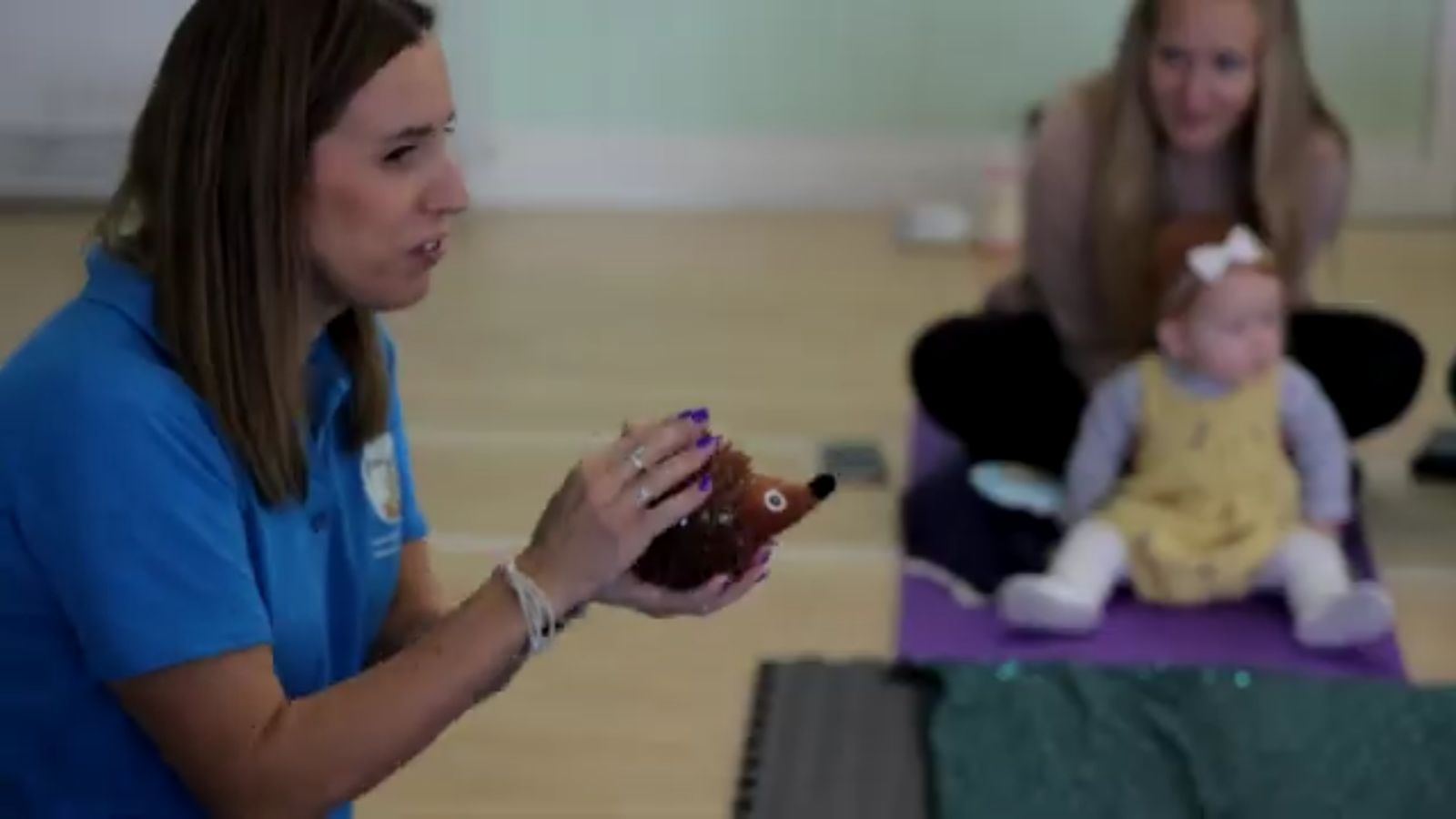
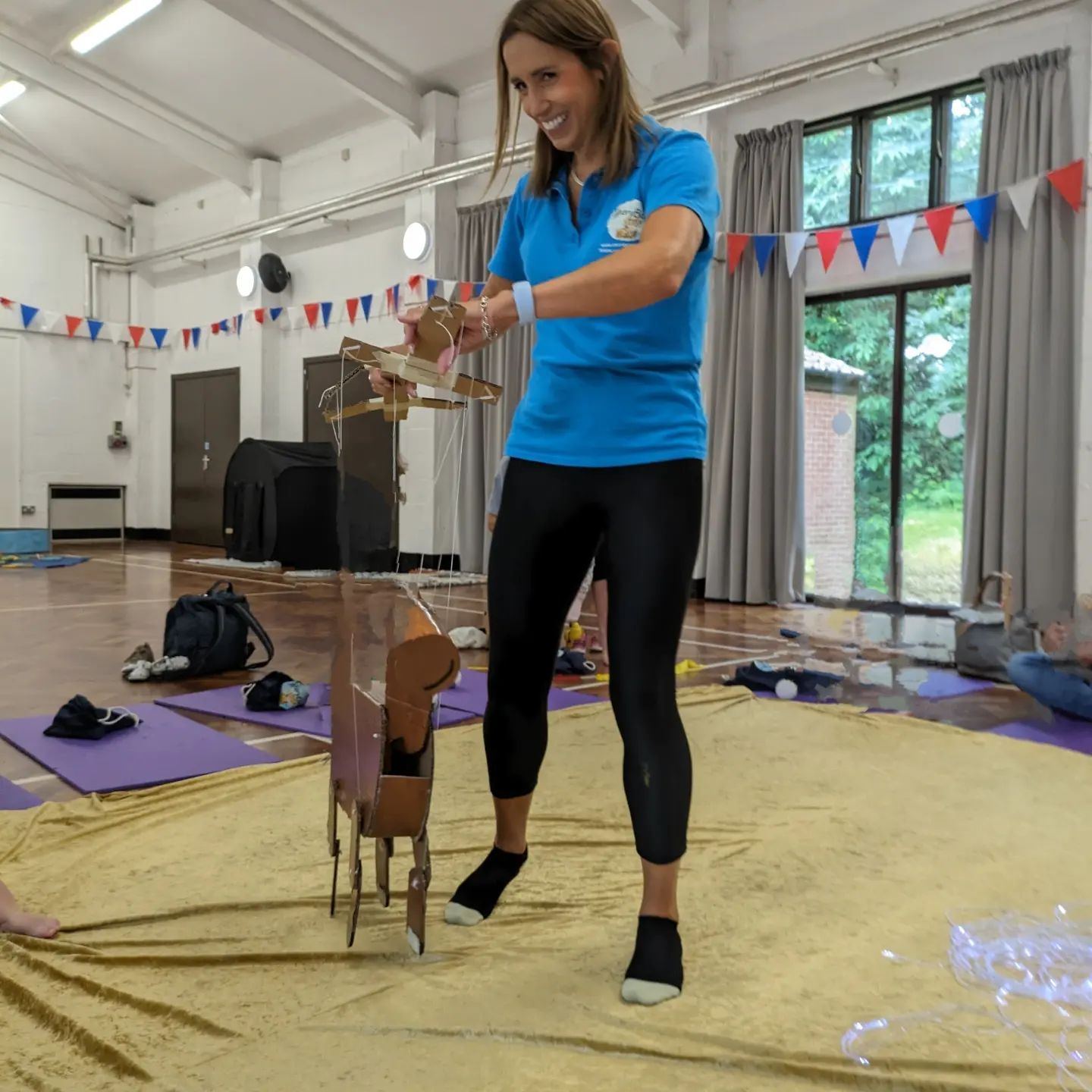
Puppets are brilliant for attention, but children learn even more from real people. In a 2023 study, children aged 4 to 6 copied adults and other children more than they copied puppets.18 We couldn’t find good studies on props, or on music matched to story moments, so we won’t claim they are proven. We use them because they bring the story to life, and life is what holds little ones’ attention.
Stories, songs and feelings
Stories give us a natural chance to talk about feelings. In Italian nurseries, toddlers whose teachers chatted about how story characters felt began using more feeling words and understood emotions better than toddlers who heard the same stories without the chat.19 The talking made the difference.
Music adds another layer. Young children read the energy of music (fast and loud, slow and soft) as an emotional clue, so a stormy cello or a gentle lullaby helps them feel what a character is feeling. You can read more about that in our post on live music.
Reading and singing in UK homes
In the National Literacy Trust’s 2026 survey of 3,194 parents of under-fives, about half read with their child every day (51.0%), and slightly more sang songs or rhymes daily (52.0%). Both figures went up from 2025, but daily reading is still well below 2019, when it was 66.1%.20 Among older children, reading for pleasure hit a 20-year low in 2025 before a small rise in 2026.21 A love of stories, started early, really matters.
What the science doesn’t say
- “Music classes make children better readers.” Rhythm and reading are linked, and music gives a small boost to sound awareness. That is helpful, but it isn’t a shortcut to reading.
- “The 30 million word gap.” This famous figure came from a study of just 42 families. Later studies found smaller and more varied differences. What matters is back-and-forth talk, songs and stories, not counting words.22
- “Baby DVDs teach words.” In one study, a month of a best-selling baby DVD taught 12 to 18-month-olds no more words than not watching it.23 Real people win again.
How this shapes a StoryBox class
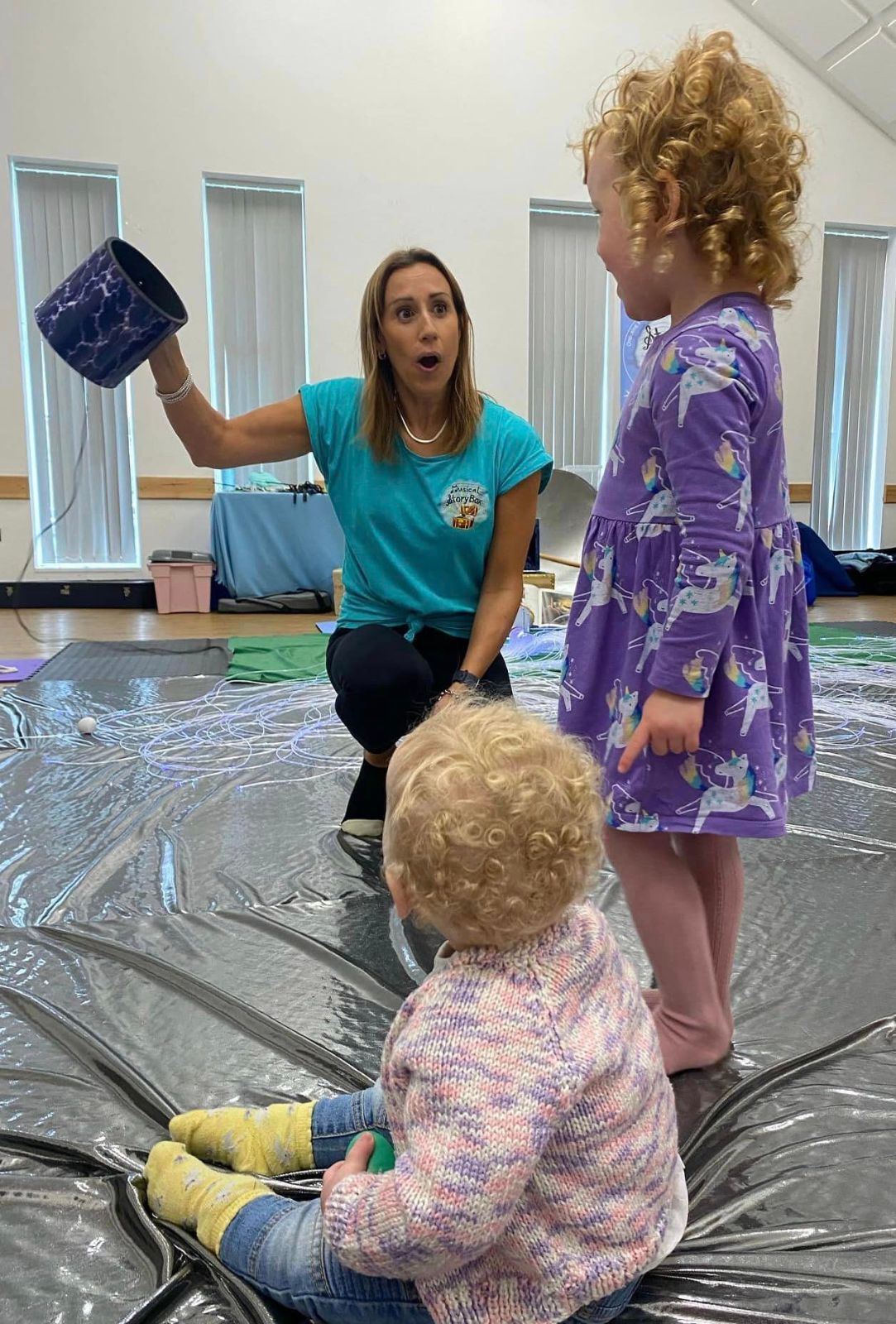
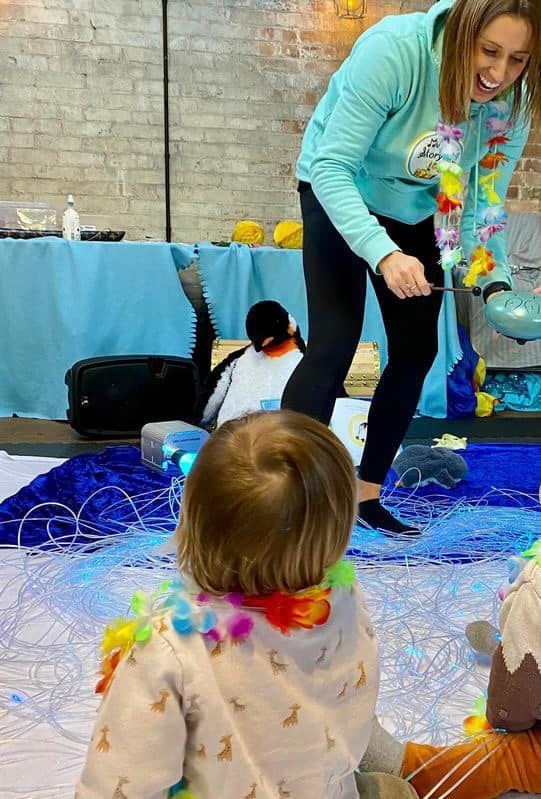
Every class is built around a picture book, such as We’re Going on a Bear Hunt, Giraffes Can’t Dance or Zog. We bring it to life with puppets, props and gestures, original songs written for each story, and music that matches each moment. We pause to wonder how the characters feel. And we use rhyme, rhythm and repetition, the building blocks of reading, all the way through.
Try it at home
Read the week’s story again at home, and let your little one turn the pages. Pause before a rhyming word and let them fill it in. Ask “how do you think he feels?” Clap the rhythm of their name. And sing the story songs: they are a lovely way to bring the book back to life at bedtime.
References
Sources checked October 2026. Where a study was small or early, we say so in the text.
- Montag JL, Jones MN, Smith LB (2015). The words children hear: picture books and the statistics for language learning. Psychological Science, 26(9), 1489–1496. doi.org/10.1177/0956797615594361
- Logan JAR, Justice LM, Yumuş M, Chaparro-Moreno LJ (2019). When children are not read to at home: the million word gap. Journal of Developmental and Behavioral Pediatrics, 40(5), 383–386. doi.org/10.1097/DBP.0000000000000657; summary: Ohio State NewsA calculation based on typical book lengths, not a measure of what children learned.
- Department for Education (2026). EYFS statutory framework for group and school-based providers. gov.uk
- Bus AG, van IJzendoorn MH, Pellegrini AD (1995). Joint book reading makes for success in learning to read: a meta-analysis on intergenerational transmission of literacy. Review of Educational Research, 65(1), 1–21. doi.org/10.3102/00346543065001001
- Mol SE, Bus AG, de Jong MT, Smeets DJH (2008). Added value of dialogic parent–child book readings: a meta-analysis. Early Education and Development, 19(1), 7–26. doi.org/10.1080/10409280701838603
- Dowdall N, Melendez-Torres GJ, Murray L, Gardner F, Hartford L, Cooper PJ (2020). Shared picture book reading interventions for child language development: a systematic review and meta-analysis. Child Development, 91(2), e383–e399. doi.org/10.1111/cdev.13225
- Noble C, Sala G, Peter M, Lingwood J, Rowland C, Gobet F, Pine J (2019). The impact of shared book reading on children’s language skills: a meta-analysis. Educational Research Review, 28, 100290. doi.org/10.1016/j.edurev.2019.100290
- François C, Teixidó M, Takerkart S, Agut T, Bosch L, Rodríguez-Fornells A (2017). Enhanced neonatal brain responses to sung streams predict vocabulary outcomes by age 18 months. Scientific Reports, 7, 12451. doi.org/10.1038/s41598-017-12798-2Small study (28 newborns).
- Snijders TM, Benders T, Fikkert P (2020). Infants segment words from songs: an EEG study. Brain Sciences, 10(1), 39. doi.org/10.3390/brainsci10010039
- Wallace WT (1994). Memory for music: effect of melody on recall of text. Journal of Experimental Psychology: Learning, Memory, and Cognition, 20(6), 1471–1485. doi.org/10.1037/0278-7393.20.6.1471; and Ludke KM, Ferreira F, Overy K (2014). Singing can facilitate foreign language learning. Memory & Cognition, 42, 41–52. doi.org/10.3758/s13421-013-0342-5
- Anvari SH, Trainor LJ, Woodside J, Levy BA (2002). Relations among musical skills, phonological processing, and early reading ability in preschool children. Journal of Experimental Child Psychology, 83(2), 111–130. Trainor Lab
- Bonacina S, Huang S, White-Schwoch T, Krizman J, Nicol T, Kraus N (2021). Rhythm, reading, and sound processing in the brain in preschool children. npj Science of Learning, 6, 20. doi.org/10.1038/s41539-021-00097-5
- Gordon RL, Fehd HM, McCandliss BD (2015). Does music training enhance literacy skills? A meta-analysis. Frontiers in Psychology, 6, 1777. doi.org/10.3389/fpsyg.2015.01777
- Zhao TC, Kuhl PK (2016). Musical intervention enhances infants’ neural processing of temporal structure in music and speech. PNAS, 113(19), 5212–5217. doi.org/10.1073/pnas.1603984113Randomised, but small (39 babies completed) and measured brain responses only.
- Bryant PE, Bradley L, Maclean M, Crossland J (1989). Nursery rhymes, phonological skills and reading. Journal of Child Language, 16(2), 407–428. doi.org/10.1017/S0305000900010485
- Vogt S, Kauschke C (2017). Observing iconic gestures enhances word learning in typically developing children and children with specific language impairment. Journal of Child Language, 44(6), 1458–1484. doi.org/10.1017/S0305000916000647
- Podlozny A (2000). Strengthening verbal skills through the use of classroom drama: a clear link. Journal of Aesthetic Education, 34(3–4), 239–276. ArtsEdSearch summary
- Stengelin R, Ball R, Maurits L, Kanngiesser P, Haun DBM (2023). Children over-imitate adults and peers more than puppets. Developmental Science, 26(2), e13303. doi.org/10.1111/desc.13303
- Grazzani I, Ornaghi V, Agliati A, Brazzelli E (2016). How to foster toddlers’ mental-state talk, emotion understanding, and prosocial behavior: a conversation-based intervention at nursery school. Infancy, 21(2), 199–227. University of Milano-Bicocca (accepted manuscript)
- National Literacy Trust (2026). Parents’ support for young children’s literacy at home in 2026. literacytrust.org.uk; the 2019 figure (66.1%) is from National Literacy Trust (2024). Parents’ support for young children’s literacy at home in 2024. literacytrust.org.uk
- National Literacy Trust (2026). Children and young people’s reading in 2026. literacytrust.org.uk
- NPR (1 June 2018). Let’s stop talking about the ‘30 million word gap’. npr.org
- DeLoache JS, Chiong C, Sherman K, et al. (2010). Do babies learn from baby media? Psychological Science, 21(11), 1570–1574. doi.org/10.1177/0956797610384145; summary: Association for Psychological Science